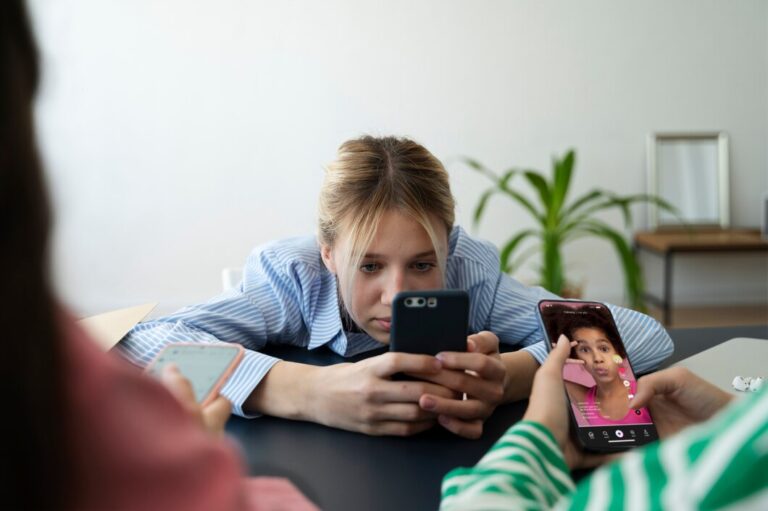
Excessive screen time—especially passive scrolling on social media and short-form video platforms—has been linked in multiple studies to reduced attention span, weaker sustained focus, and increased mental fatigue. However, not all screen time is harmful. Purposeful use (learning, work, skill-building) can enhance cognitive performance. The key factor is how screens are used, not just how long.
Key Takeaways
- Screen time impacts mental focus differently depending on content type and usage pattern
- Short-form, high-dopamine content reduces sustained attention ability
- Educational and task-based screen use can improve cognitive skills
- Multitasking across devices significantly reduces productivity
- Recovery of focus is possible through behavioral and digital habits
- Sleep disruption from screen exposure is a major indirect factor affecting attention
Why You Can’t Focus Like You Used To
Have you ever sat down to work… only to pick up your phone five minutes later without even realizing it?
You’re not alone.
Across the world, people are reporting the same issue: shortened attention span, mental fatigue, and constant distraction. And at the center of this modern struggle is one powerful factor—screen time.
But here’s the real question researchers are asking:
Is screen time actually destroying mental focus—or are we using it wrong?
The answer is more nuanced than viral headlines suggest. Research in neuroscience, psychology, and behavioral science reveals a complex relationship between screen exposure and cognitive performance.
In this guide, we’ll break down exactly what science says about screen time vs mental focus, how your brain responds to digital stimulation, and what you can do to regain control of your attention.
What Is Screen Time? (Definition for Clarity)
Screen time refers to the total duration spent using digital devices such as smartphones, tablets, computers, and televisions.
But modern research breaks it into categories:
Types of Screen Time
- Passive consumption: scrolling social media, watching videos
- Interactive use: gaming, messaging, browsing
- Productive use: studying, working, creating content
- Multitasking use: switching between apps or tabs rapidly
👉 Not all screen time affects the brain in the same way.
How Mental Focus Works in the Brain
To understand screen time impact, we need to understand focus itself.
Mental focus involves three key systems:
- Attention control system (prefrontal cortex)
- Reward system (dopamine pathways)
- Memory system (hippocampus)
When you focus deeply:
- The prefrontal cortex suppresses distractions
- Dopamine stabilizes motivation
- Memory encoding improves
But screens—especially fast-paced content—constantly trigger the reward system.
This creates a loop:
Stimulus → Dopamine spike → Distraction → New stimulus
Over time, this can train the brain to prefer quick rewards over sustained effort.
What Research Says About Screen Time and Mental Focus
1. Attention Span Decline and Digital Overload
Studies suggest that frequent exposure to rapid digital stimuli can reduce the ability to sustain attention on slower tasks.
Key findings:
- People switch tasks more frequently after heavy digital use
- Reading long-form content becomes harder
- Deep work duration decreases
However, researchers emphasize:
It is not screen time alone, but fragmented attention habits that cause the biggest impact.
2. Social Media and Dopamine Response
Platforms like Instagram, TikTok, and YouTube Shorts are designed around:
- Infinite scrolling
- Variable rewards
- Short video loops
This leads to:
- Frequent dopamine spikes
- Reduced tolerance for boredom
- Increased craving for stimulation
Over time, this can make:
- Studying feel “boring”
- Work feel “slow”
- Real-life tasks feel “unrewarding”
3. Multitasking Reduces Cognitive Performance
One of the strongest findings in cognitive science:
Multitasking reduces productivity by up to 40% in complex tasks.
Switching between tabs, apps, or notifications:
- Increases cognitive load
- Reduces working memory efficiency
- Slows decision-making
Your brain doesn’t truly multitask—it context switches rapidly, which is mentally expensive.
4. Screen Time and Sleep Disruption
Sleep is directly tied to focus.
Excessive evening screen use:
- Suppresses melatonin
- Delays sleep onset
- Reduces deep sleep quality
Poor sleep leads to:
- Reduced attention span
- Memory issues
- Emotional instability
This is one of the strongest indirect effects of screen time on mental focus.
5. Not All Screen Time Is Harmful
This is where most discussions become misleading.
Research clearly shows:
Beneficial screen time includes:
- Learning new skills online
- Work-related tasks
- Problem-solving activities
- Creative production (design, writing, coding)
These activities can:
- Strengthen cognitive abilities
- Improve attention control
- Enhance working memory
👉 The brain adapts to what you repeatedly do.
Screen Time vs Mental Focus: A Clear Comparison Table
| Factor | High-Quality Screen Use | Low-Quality Screen Use |
| Attention impact | Improves focus | Weakens sustained attention |
| Dopamine response | Stable | Overstimulated |
| Cognitive load | Structured | Fragmented |
| Productivity | High | Low |
| Memory retention | Strong | Weak |
Why Screen Time Affects Focus Differently for Everyone
Individual differences matter:
1. Age
Younger brains are more plastic and sensitive to digital stimulation.
2. Content type
Educational vs entertainment content has opposite effects.
3. Duration patterns
2 hours of deep work ≠ 2 hours of scrolling.
4. Sleep habits
Poor sleep amplifies screen-related focus issues.
5. Baseline attention ability
People with existing attention challenges may feel stronger effects.
Common Myths vs Facts
Myth 1: “All screen time is bad”
Fact: Purpose-driven screen use can improve cognition.
Myth 2: “Screens permanently damage your brain”
Fact: Effects are behavioral and reversible.
Myth 3: “Attention span is disappearing”
Fact: Attention is shifting, not disappearing.
Myth 4: “Only kids are affected”
Fact: Adults show similar cognitive patterns.
Expert Insight: What Neuroscience Suggests
Neuroscience research highlights a key principle:
The brain adapts to reward frequency, not just content type.
This means:
- Frequent rewards = short attention preference
- Delayed rewards = deep focus ability
This is why habits matter more than total screen time.
Practical Strategies to Improve Mental Focus
1. Use the 20–20–20 Rule
Every 20 minutes:
- Look 20 feet away
- For 20 seconds
Reduces cognitive fatigue.
2. Switch to “Intentional Screen Use”
Before opening apps, ask:
- Why am I opening this?
- What is the outcome?
3. Eliminate Notification Interruptions
Notifications are attention fragmentation triggers.
4. Practice Deep Work Blocks
- 45–90 minutes focused work
- No phone or tabs switching
5. Replace Passive Scrolling
Replace with:
- Reading
- Walking
- Skill learning
- Journaling
6. Digital Sunset Rule
Avoid screens 60–90 minutes before sleep.
7. Single-Tasking Habit
Train your brain to do one thing at a time.
Checklist: Healthy Screen Time Habits
- No phone during first 30 minutes of waking
- No multitasking during work sessions
- Screen breaks every hour
- Limited social media consumption
- Screen-free bedtime routine
- Intentional app usage only
Future Trends: Screen Time & Attention Economy
Experts predict:
1. AI-driven personalization will increase screen engagement
More addictive content loops
2. Attention will become a “premium resource”
Focus will be a competitive advantage
3. Digital wellness tools will grow
Apps that monitor and limit usage
4. Education systems will adapt
Focus training may become part of curricula
Frequently Asked Questions (FAQ)
1. Does screen time reduce attention span?
Yes, especially when it involves fast-paced and fragmented content consumption.
2. How much screen time is too much?
There is no fixed number, but excessive passive use (3–5+ hours daily) is linked with reduced focus.
3. Can screen time improve mental skills?
Yes, educational and skill-based screen use can improve cognition.
4. Why do I lose focus after using my phone?
Because of dopamine-driven stimulation that conditions the brain for constant novelty.
5. Is social media worse than other screen activities?
Yes, due to its high-reward, fast-scroll design.
6. Can focus be restored after heavy screen use?
Yes, through habit changes, sleep improvement, and digital detox practices.
7. Does screen time affect productivity?
Yes, especially through multitasking and distraction cycles.
8. Is reading on screens bad for focus?
Not necessarily—context matters. Reading long-form content can improve focus.
9. What is the best way to reduce screen addiction?
Gradual reduction, replacing habits, and setting intentional usage rules.
10. Are children more affected by screen time?
Yes, due to developing cognitive systems, but adults are also affected.
Conclusion: The Real Truth About Screen Time vs Mental Focus
The relationship between screen time and mental focus is not black and white.
It’s not about completely avoiding screens—it’s about how you use them, when you use them, and what patterns you repeat daily.
If screen time is fragmented, addictive, and passive, it weakens attention.
If it is intentional, structured, and purposeful, it can strengthen cognitive abilities.
Your focus is not gone—it is being trained every day by your digital habits.
The good news?
You can retrain it.
About the Author